The Tipping Point (2000)

By Malcolm Gladwell (Back Bay Books)

“The best way to understand the dramatic transformation of unknown books into bestsellers, or the rise of teenage smoking, or the phenomena of word of mouth or any number of the other mysterious changes that mark everyday life,” writes Malcolm Gladwell, “is to think of them as epidemics. Ideas and products and messages and behaviors spread just like viruses do.” Although anyone familiar with the theory of memetics will recognize this concept, Gladwell’s The Tipping Point has quite a few interesting twists on the subject.”

“For example, Paul Revere was able to galvanize the forces of resistance so effectively in part because he was what Gladwell calls a “Connector”: he knew just about everybody, particularly the revolutionary leaders in each of the towns that he rode through. But
Revere “wasn’t just the man with the biggest Rolodex in colonial Boston,” he was also a “Maven” who gathered extensive information about the British. He knew what was going on and he knew exactly whom to tell. The phenomenon continues to this day–think of how often you’ve received information in an e-mail message that had been forwarded at least half a dozen times before reaching you.

Gladwell develops these and other concepts (such as the “stickiness” of ideas or the
effect of population size on information dispersal) through simple, clear explanations and entertainingly illustrative anecdotes, such as comparing the pedagogical methods of Sesame Street and Blue’s Clues, or explaining why it would be even easier to play Six Degrees of Kevin Bacon with the actor Rod Steiger. Although some readers may find the
transitional passages between chapters hold their hands a little too tightly, and Gladwell’s closing invocation of the possibilities of social engineering sketchy, even chilling, The Tipping Point is one of the most effective books on science for a general audience in ages. It seems inevitable that “tipping point,” like “future shock” or
“chaos theory,” will soon become one of those ideas that everybody knows–or at least knows by name.”

–Ron Hogan

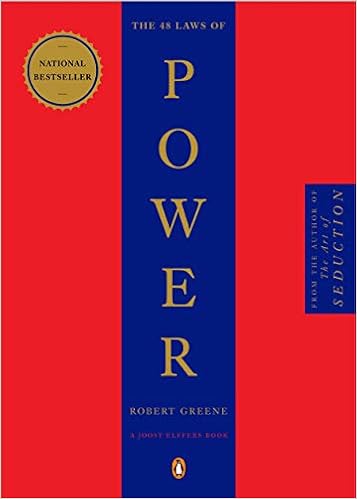
The 48 Laws of Power (2000)

By Robert Greene (Penguin)

To be taken with a considerable grain of salt, this book is a worthy update of and complements Machiavelli’s almost 500-years old treatise of power and politics.

“Amoral or immoral, this compendium aims to guide those who embrace power as a ruthless game, and will entertain the rest. Elffers’s layout (he is identified as the co-conceiver and designer in the press release) is stylish, with short epigrams set in red at the margins. Each law, with such allusive titles as “Pose as a Friend, Work as a
Spy,” “Get Others to Do the Work for You, But Always Take the Credit,” “Conceal Your Intentions,” is demonstrated in four ways: using it correctly, failing to use it, key aspects of the law and when not to use it. Illustrations are drawn from the courts of modern and ancient Europe, Africa and Asia, and devious strategies culled from well-known
personae: Machiavelli, Talleyrand, Bismarck, Catherine the Great, Mao, Kissinger, Haile Selassie, Lola Montes and various con artists of our century. These historical escapades make enjoyable reading, yet by the book’s conclusion, some protagonists have appeared too many times and seem drained. Although gentler souls will find this book frightening, those whose moral compass is oriented solely to power will have a
perfect vade mecum.”

Copyright 1998 Reed Business Information, Inc.

2007 Academy of Management Annual Meeting

In 2007, the Academy of Management Annual Meeting will be hosted by my wife’s beloved hometown Philadelphia, PA. Under the conference theme “Doing well by doing good”, we will present our paper:

  • “What’s in a tie? Knowledge transfer and the dimensions of dyadic social capital” with Daniel Z. Levin (Rutgers University) & Melissa M. Appleyard (Portland State University).

The conference will take place August 3-8, 2007. For more information, check the AOM website.

This trip also offers an opportunity to visit my old friend Florian, who is currently holding a postdoctoral position at the University of Pennsylvania, and his wife Andrea during the last 4 months of their stay in this fantastic city.

2006 SMS Annual International Conference

This year’s Strategic Management Society’s Annual International Conference with the title “Strategy and Governance in a World of Institutional Change” took place October 29 – November 1 in Vienna, Austria. Together with my co-authors I presented the paper:

  • “Organizational structure and corporate entrepreneurship: A simulation model” with Dirk Martignoni (University of St. Gallen) & Franz W. Kellermanns (Mississippi State University).

For more information on the SMS Conference, visit their website.

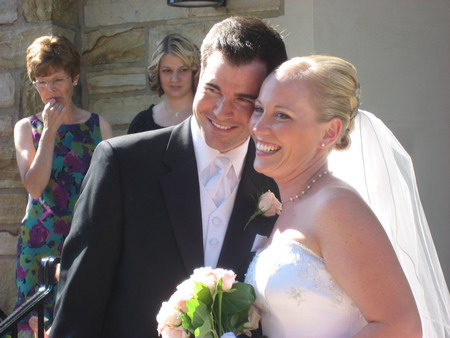
Wedding Ceremony

wedding2006

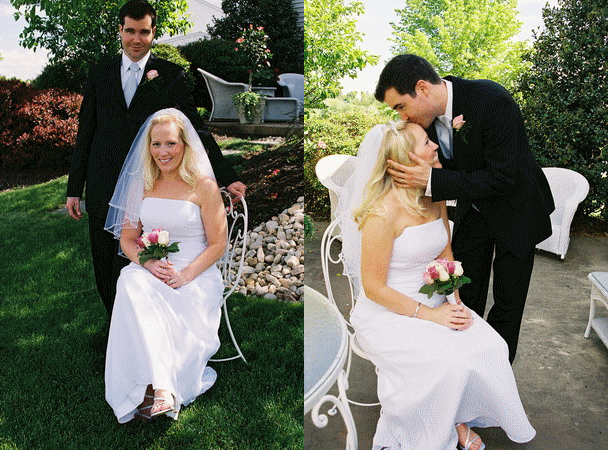
On August 5, 2006, Erin and I celebrated our church wedding with a great reception in Philadelphia, PA.

What made this beautiful day even more special was that we could share it with so many friends & family from both the U.S. and abroad…

2006 AOM Annual Meeting in Atlanta, GA

This year’s Academy of Management Annual Meeting with the title “Knowledge, Action and the Public Concern” took place August 11-16 in Atlanta, GA. Although I could not participate due to my wedding in Philadelphia, my co-authors presented our paper:

  • “To agree or not to agree? A meta-analytical review of strategic consensus and performance” with Franz W. Kellermanns (Mississippi State University), John C. Shaw (Mississippi State University), Christoph Lechner (University of St. Gallen), & Steven W. Floyd (University of Connecticut).

Wedding Planning

Here is the information on our upcoming wedding in August 2006 in Philadelphia, PA.

Program Overview:

Date
Program
July 29-31 Atlantic City
July 31-August 2 Washington D.C.
August 2 Philadelphia
August 3 Rehearsal Dinner in Jamison, PA
August 4 Guided City Tour of Philadelphia, PA
Dinner in Philadelphia
August 5, 3pm Wedding at St. Katherine of Siena
Reception at Springmill Manor
August 6, 11am Brunch at the William Penn Inn
August 6-7 Departure

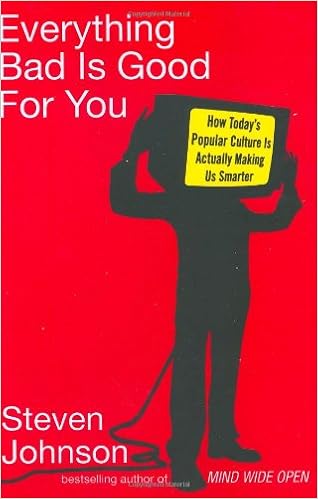
Everything Bad Is Good For You (2005)

By Steven Johnson (Riverhead)

In his fourth book, Everything Bad Is Good for You, iconoclastic science writer Steven Johnson (who used himself as a test subject for the latest neurological technology in his last book, Mind Wide Open) takes on one of the most widely held preconceptions of the postmodern world–the belief that video games, television shows, and other forms of popular entertainment are detrimental to Americans’ cognitive and moral development. Everything Good builds a case to the contrary that is engaging, thorough, and ultimately convincing.

The heart of Johnson’s argument is something called the Sleeper Curve–a universe of popular entertainment that trends, intellectually speaking, ever upward, so that today’s pop-culture consumer has to do more “cognitive work”–making snap decisions and coming up with long-term strategies in role-playing video games, for example, or
mastering new virtual environments on the Internet– than ever before. Johnson makes a compelling case that even today’s least nutritional TV junk food–the Joe Millionaires and Survivors so commonly derided as evidence of America’s cultural decline–is more complex and stimulating, in terms of plot complexity and the amount of external
information viewers need to understand them, than the Love Boats and I Love Lucys
that preceded it. When it comes to television, even (perhaps especially) crappy television, Johnson argues, “the content is less interesting than the cognitive work the show elicits from your mind.”

Johnson’s work has been controversial, as befits a writer willing to challenge wisdom so conventional it has ossified into accepted truth. But even the most skeptical readers should be captivated by the intriguing questions Johnson raises, whether or not they choose to accept his answers. –Erica C. Barnett, Amazon.com

Six Degrees: The Science of a Connected Age (2003)

By Duncan J. Watts (W. W. Norton)

Duncan J. Watts, one of the principal architects of network theory, sets out to explain the innovative research he and other scientists are spearheading to create a blueprint of our connected planet.

You may be only six degrees away from Kevin Bacon, but would he let you borrow his car? It depends on the structures within the network that links you. When the power goes out, when we find that a stranger knows someone we know, when dot-com stocks soar in price, networks are evident. In Six Degrees, sociologist Duncan Watts examines networks like these: what they are, how they’re being studied, and what we can use them for. To illustrate the often complicated mathematics that describe such structures, Watts uses plenty of examples from life, without which this book would quickly move beyond a general science readership. Small chapters make each thought-provoking conclusion easy to swallow, though some are hard to digest. For instance, in a short bit on “coercive externalities,” Watts sums up sociological research showing that:

“Conversations concerning politics displayed a consistent pattern …. On election day, the strongest predictor of electoral success was not which party an individual privately supported but which party he or she expected would win.”

Six Degrees attempts to help readers understand the new and exciting field of networks and complexity. While considerably more demanding than a general book like The Tipping Point, it offers readers a snapshot of a riveting moment in science, when understanding things like disease epidemics and the stock market seems almost within our reach.

–Therese Littleton, Amazon.com

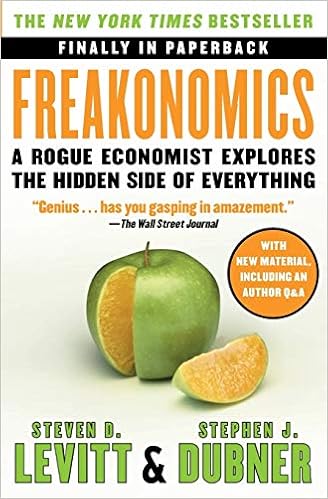
Freakonomics (2005)

By Steven D. Levitt & Stephen J. Dubner (Morrow)

Through forceful storytelling and wry insight, Levitt and co-author Stephen J. Dubner show that economics is, at root, the study of incentives – how people get what they want, or need, especially when other people want or need the same thing. In Freakonomics, they set out to explore the hidden side of … well, everything.

Which is more dangerous, a gun or a swimming pool? What do schoolteachers and sumo wrestlers have in common? Why do drug dealers still live with their moms? How much do parents really matter? What kind of impact did Roe v. Wade have on violent crime?

These may not sound like typical questions for an economist to ask. But Steven D. Levitt is not a typical economist. He is a much-heralded young scholar who studies the riddles of everyday life-from cheating and crime to sports and child-rearing – and whose conclusions regularly turn the conventional wisdom on its head. He usually begins with a mountain of data and a simple, unasked question. Some of these questions concern life-and-death issues; others have an admittedly freakish quality. Thus the new field of study contained in this book: Freakonomics.

Through forceful storytelling and wry insight, Levitt and co-author Stephen J. Dubner show that economics is, at root, the study of incentives – how people get what they want, or need, especially when other people want or need the same thing. In Freakonomics, they set out to explore the hidden side of … well, everything. The inner workings of
a crack gang. The truth about real-estate agents. The myths of campaign finance. The telltale marks of a cheating schoolteacher. The secrets of the Ku Klux Klan.

What unites all these stories is a belief that the modern world, despite a surfeit of obfuscation, complication, and downright deceit, is not impenetrable, is not unknowable, and – if the right questions are asked – is even more intriguing than we think. All it takes is a new way of looking. Steven Levitt, through devilishly clever and
clear-eyed thinking, shows how to see through all the clutter.

Freakonomics establishes this unconventional premise: if morality represents how we would like the world to work, then economics represents how it actually does work. It is true that readers of this book will be armed with enough riddles and stories to last a thousand cocktail parties. But Freakonomics can provide more than that. It will
literally redefine the way we view the modern world.

(Front Flap Text)

Colleagues win SMS Best Conference Paper Prize

I am very glad to announce that my mentor at the University of St. Gallen, Christoph Lechner, and my mentor at the University of Connecticut, Steven W. Floyd, won the prestigious Strategic Management Society (SMS) Best Conference Paper Prize for their paper:

“The role of authority, justification, and coalition-building in strategic renewal.”

Congratulations also from my side for this tremendous achievement!

2005 SMS Annual International Meeting

In spite of the hurricane “Wilma”, this year’s Annual International Meeting of the Strategic Management Society took place in the Walt Disney World Resort in Orlando, FL. The theme for this year was “Strategic Management Achievements & Opportunities”.

wilma

Together with my co-authors, I presented two papers there:

  • “Strategic decision-making at the firm and alliance level: An empirical study” with Franz W. Kellermanns (Mississippi State University), and
  • “Motives and outcomes of technology licensing: An exploratory study of the
    pharmaceutical and computer industries” with Melissa A. Schilling (New York University).

For more information on the SMS Meeting, visit their website.

JOM Article Published

New Article Published in the Journal of Management 31(5): 719-737

The Lack of Consensus About Strategic Consensus: Advancing Theory and Research

Franz W. Kellermanns*, Jorge Walter**, Christoph Lechner***, & Steven W. Floyd**

* Mississippi State University, ** University of Connecticut, *** University of St. Gallen

The purpose of this article is to describe the theoretical and methodological reasons for the inconsistent findings on the value of strategic consensus. This analysis suggests the need for (a) definitions of consensus that align the locus and content of agreement with the study context and theoretical premises; (b) measures of consensus that take account of locus as well as differences in how the content of strategy is perceived by top-, middle-, and lower-level managers; (c) research designs wherein assumptions about the locus and content of consensus govern the choice of antecedents; and (d) more consistent use of moderators.

Keywords: Strategic consensus; consensus decision making; strategic decision making

For a copy of this paper, see here.

2005 Academy of Management Annual Meeting

hawaii2005

The Academy of Management Annual Meeting took place from August 5-10,
2005, in Honolulu, Hawaii, and featured the theme “A new vision of
management in the 21st century”. For more information about the meeting
see their website.

Together with my co-authors, I presented two papers at this year’s AOM Annual Meeting:

  • ‘Resource-based and network-based motives for technology licensing: An exploratory study’, with Melissa A. Schilling (New York University).
  • ‘Together or apart? An empirical investigation of decision making within and between alliance partners’, with Christoph Lechner (University of St. Gallen).

“You’ve got to do what you love”

Image result for Commencement address by Steve Jobs, CEO of Apple Computer and of Pixar Animation Studios

Here is the text of the Commencement address by Steve Jobs, CEO of Apple Computer and of Pixar Animation Studios, delivered on June 12, 2005.

“I am honored to be with you today at your commencement from one of the finest universities in the world. I never graduated from college. Truth be told, this is the closest I’ve ever gotten to a college graduation. Today I want to tell you three stories from my life. That’s it. No big deal. Just three stories.

The first story is about connecting the dots.

I dropped out of Reed College after the first 6 months, but then stayed around as a drop-in for another 18 months or so before I really quit. So why did I drop out?

It started before I was born. My biological mother was a young, unwed college graduate student, and she decided to put me up for adoption. She felt very strongly that I should be adopted by college graduates, so everything was all set for me to be adopted at birth by a lawyer and his wife. Except that when I popped out they decided at the last minute that they really wanted a girl. So my parents, who were on a waiting list, got a call in the middle of the night asking: “We have an unexpected baby boy; do you want him?” They said: “Of course.” My biological mother later found out that my mother had never graduated from college and that my father had never graduated from high school.
She refused to sign the final adoption papers. She only relented a few months later when my parents promised that I would someday go to college.

And 17 years later I did go to college. But I naively chose a college that was almost as expensive as Stanford, and all of my working-class parents’ savings were being spent on my college tuition. After six months, I couldn’t see the value in it. I had no idea what I
wanted to do with my life and no idea how college was going to help me figure it out. And here I was spending all of the money my parents had saved their entire life. So I decided to drop out and trust that it would all work out OK. It was pretty scary at the time, but looking back it was one of the best decisions I ever made. The minute I dropped out I could stop taking the required classes that didn’t interest me,
and begin dropping in on the ones that looked interesting.

It wasn’t all romantic. I didn’t have a dorm room, so I slept on the floor in friends’ rooms, I returned coke bottles for the 5¢ deposits to buy food with, and I would walk the 7 miles across town every Sunday night to get one good meal a week at the Hare Krishna temple. I loved it. And much of what I stumbled into by following my curiosity and
intuition turned out to be priceless later on. Let me give you one example:

Reed College at that time offered perhaps the best calligraphy instruction in the country. Throughout the campus every poster, every label on every drawer, was beautifully hand calligraphed. Because I had dropped out and didn’t have to take the normal classes, I decided to take a calligraphy class to learn how to do this. I learned about serif and san serif typefaces, about varying the amount of space between different letter combinations, about what makes great typography great. It was beautiful, historical, artistically subtle in a way that science can’t capture, and I found it fascinating.

None of this had even a hope of any practical application in my life. But ten years later, when we were designing the first Macintosh computer, it all came back to me. And we designed it all into the Mac. It was the first computer with beautiful typography. If I had never dropped in on that single course in college, the Mac would have never had multiple typefaces or proportionally spaced fonts. And since Windows just copied the Mac, its likely that no personal computer would have them. If I had never dropped out, I would have never dropped in on this calligraphy class, and personal computers might not have the wonderful typography that they do. Of course it was impossible to
connect the dots looking forward when I was in college. But it was very, very clear looking backwards ten years later.

Again, you can’t connect the dots looking forward; you can only connect them looking backwards. So you have to trust that the dots will somehow connect in your future. You have to trust in something — your gut, destiny, life, karma, whatever. This approach has never let me down, and it has made all the difference in my life.

My second story is about love and loss.

I was lucky — I found what I loved to do early in life. Woz and I started Apple in my parents garage when I was 20. We worked hard, and in 10 years Apple had grown from just the two of us in a garage into a $2 billion company with over 4000 employees. We had just released our finest creation — the Macintosh — a year earlier, and I had just turned 30. And then I got fired. How can you get fired from a company you started? Well, as Apple grew we hired someone who I thought was very talented to run the company with me, and for the first year or so things went well. But then our visions of the future began to diverge and eventually we had a falling out. When we did, our Board of Directors sided with him. So at 30 I was out. And very publicly out. What had been the focus of my entire adult life was gone, and it was devastating.

I really didn’t know what to do for a few months. I felt that I had let the previous generation of entrepreneurs down – that I had dropped the baton as it was being passed to me. I met with David Packard and Bob Noyce and tried to apologize for screwing up so badly. I was a very public failure, and I even thought about running away from the valley. But something slowly began to dawn on me — I still loved what I did. The turn of events at Apple had not changed that one bit. I had been rejected, but I was still in love. And so I decided to start over.

I didn’t see it then, but it turned out that getting fired from Apple was the best thing that could have ever happened to me. The heaviness of being successful was replaced by the lightness of being a beginner again, less sure about everything. It freed me to enter one of the most creative periods of my life.

During the next five years, I started a company named NeXT, another company named Pixar, and fell in love with an amazing woman who would become my wife. Pixar went on to create the worlds first computer animated feature film, Toy Story, and is now the most successful animation studio in the world. In a remarkable turn of events, Apple bought NeXT, I retuned to Apple, and the technology we developed at NeXT is at the heart of Apple’s current renaissance. And Laurene and I have a wonderful family together.

I’m pretty sure none of this would have happened if I hadn’t been fired from Apple. It was awful tasting medicine, but I guess the patient needed it. Sometimes life hits you in the head with a brick. Don’t lose faith. I’m convinced that the only thing that kept me going was that I loved what I did. You’ve got to find what you love. And that is as true for your work as it is for your lovers. Your work is going to fill a large part of your life, and the only way to be truly satisfied is to do what you believe is great work. And the only way to do great work is to love what you do. If you haven’t found it yet, keep
looking. Don’t settle. As with all matters of the heart, you’ll know when you find it. And, like any great relationship, it just gets better and better as the years roll on. So keep looking until you find it. Don’t settle.

My third story is about death.

When I was 17, I read a quote that went something like: “If you live each day as if it was your last, someday you’ll most certainly be right.” It made an impression on me, and since then, for the past 33 years, I have looked in the mirror every morning and asked myself: “If today were the last day of my life, would I want to do what I am about to do today?” And whenever the answer has been “No” for too many days in a row, I know I need to change something.

Remembering that I’ll be dead soon is the most important tool I’ve ever encountered to help me make the big choices in life. Because almost everything — all external expectations, all pride, all fear of embarrassment or failure – these things just fall away in the face of death, leaving only what is truly important. Remembering that you are
going to die is the best way I know to avoid the trap of thinking you have something to lose. You are already naked. There is no reason not to follow your heart.

About a year ago I was diagnosed with cancer. I had a scan at 7:30 in the morning, and it clearly showed a tumor on my pancreas. I didn’t even know what a pancreas was. The doctors told me this was almost certainly a type of cancer that is incurable, and that I should expect to live no longer than three to six months. My doctor advised me to go
home and get my affairs in order, which is doctor’s code for prepare to die. It means to try to tell your kids everything you thought you’d have the next 10 years to tell them in just a few months. It means to make sure everything is buttoned up so that it will be as easy as possible for your family. It means to say your goodbyes.

I lived with that diagnosis all day. Later that evening I had a biopsy, where they stuck an endoscope down my throat, through my stomach and into my intestines, put a needle into my pancreas and got a few cells from the tumor. I was sedated, but my wife, who was there, told me that when they viewed the cells under a microscope the doctors
started crying because it turned out to be a very rare form of pancreatic cancer that is curable with surgery. I had the surgery and I’m fine now.

This was the closest I’ve been to facing death, and I hope its the closest I get for a few more decades. Having lived through it, I can now say this to you with a bit more certainty than when death was a useful but purely intellectual concept:

No one wants to die. Even people who want to go to heaven don’t want to die to get there. And yet death is the destination we all share. No one has ever escaped it. And that is as it should be, because Death is very likely the single best invention of Life. It is Life’s change agent. It clears out the old to make way for the new. Right now the new is you, but someday not too long from now, you will gradually become the old and be cleared away. Sorry to be so dramatic, but it is quite true.

Your time is limited, so don’t waste it living someone else’s life. Don’t be trapped by dogma — which is living with the results of other people’s thinking. Don’t let the noise of others’ opinions drown out your own inner voice. And most important, have the courage to follow your heart and intuition. They somehow already know what you truly want
to become. Everything else is secondary.

When I was young, there was an amazing publication called The Whole Earth Catalog,
which was one of the bibles of my generation. It was created by a fellow named Stewart Brand not far from here in Menlo Park, and he brought it to life with his poetic touch. This was in the late 1960’s, before personal computers and desktop publishing, so it was all made with typewriters, scissors, and polaroid cameras. It was sort of like Google in paperback form, 35 years before Google came along: it was idealistic, and overflowing with neat tools and great notions.

Stewart and his team put out several issues of The Whole Earth Catalog, and then when it had run its course, they put out a final issue. It was the mid-1970s, and I was your age. On the back cover of their final issue was a photograph of an early morning country road, the kind you might find yourself hitchhiking on if you were so adventurous. Beneath it were the words: “Stay Hungry. Stay Foolish.” It was their farewell message as they signed off. Stay Hungry. Stay Foolish. And I have always wished that for myself. And now, as you graduate to begin anew, I wish that for you.

Stay Hungry. Stay Foolish.

Thank you all very much.”

Erin & Jorge’s Civil Wedding

wedding2005

“Introducing for the first time the new Mr. and Mrs. Jorge Walter.”

On May 21, 2005, Erin and I got married in a civil ceremony with only the closest family and friends in Bucks County, PA.

Our church wedding and reception with everyone is planned for August 5th, 2006, in Philadelphia, PA.

Graduation

graduation

After more than 4 years of hard work, I attended my doctoral gradation ceremony in St. Gallen, Switzerland.

Thank you to my family & friends who supported me throughout this time and were there for me, always, and to my advisers Prof. Guenter Mueller-Stewens (left), Prof. Christoph Lechner (right), & Prof. Georg von Krogh (not in the picture).