This year’s Strategic Management Society’s Annual International Conference with the title "The Challenges of Non-Market Influences on Market Strategies" is taking place October 14-17 in San Diego, CA. My co-authors and I are scheduled to present our paper:
"Friend Or Foe? Corporate Control And Strategic Decision-Making Speed At The SBU Level" with Maximilian Kownatzki (Mercer Management Consulting) and Christoph Lechner (University of St. Gallen).
For more information on the conference, check out their website.
It is with great joy that we announce the birth of our daughter Sophia Leyna Walter. She was born on 09/08/2007 at 9am, weighed 6 pounds, 5 ounces (2864 grams), and was 19 inches (48 centimeters) tall.
“Given the opportunity to watch the inner workings of his own brain, Steven Johnson jumps at the chance. He reveals the results in Mind Wide Open, an engaging and personal account of his foray into edgy brain science.”
“In the 21st century, Johnson observes, we have become used to ideas such as ‘adrenaline rushes’ and ‘serotonin levels,’ without really recognizing that complex neurobiology has become a commonplace thing to talk about. He sees recent laboratory revelations about the brain as crucial for understanding ourselves and our psyches in new, post-Freudian ways. Readers shy about slapping electrodes on their own temples can get a vicarious scientific thrill as Johnson tries out empathy tests, neurofeedback, and fMRI scans. The results paint a distinct picture of the author, and uncover general brain secrets at the same time. Memory, fear, love, alertness–all the multitude of states housed in our brains are shown to be the results of chemical and electrical interactions constantly fed and changed by input from our senses. Mind Wide Open both satisfies curiosity and provokes more questions, leaving readers wondering about their own gray matter.”
My co-authors and I have received an invitation to the 2007 Society of Entrepreneurship Scholars Conference.
Included in the conference program is a Manuscript Boot-Camp, where we will present the paper:
“Empirical validation of resource-evaluation frameworks: A judgment analysis perspective,” with Benedict Kemmerer (BSH Bosch und Siemens Hausgeraete GmbH), Franz W. Kellermanns (Mississippi State University), and V.K. Narayanan (Drexel University).
The conference will take place August 16-19 at Ohio State University, Columbus, OH, and Franz will present the paper on our behalf.
Knowledge Transfer Between and Within Alliance Partners: Private Versus Collective Benefits of Social Capital
Jorge Walter*, Christoph Lechner*, & Franz W. Kellermanns***
* Portland State University, ** University of St. Gallen, *** Mississippi State University
This article examines the process through which multilevel network structures translate into knowledge acquisition from alliance partners. The degree of knowledge transfer a multidivisional company achieves from its network of alliance partners is determined not only by the organization’s external network structure, but also by the structure of relationships among its business units. By distinguishing two perspectives on the distribution of social capital’s benefits – private versus collective – this article’s approach
reconciles the competing views on what types of network structures create social capital, that is, the brokerage and closure views of the social network literature. Private benefits of brokerage and centrality are more beneficial in interfirm networks, whereas collective benefits provided by network closure and low levels of centralization are more beneficial in intrafirm networks.
Keywords: Inter- and intrafirm networks; knowledge transfer; social capital; strategic alliances
“The best way to understand the dramatic transformation of unknown books into bestsellers, or the rise of teenage smoking, or the phenomena of word of mouth or any number of the other mysterious changes that mark everyday life,” writes Malcolm Gladwell, “is to think of them as epidemics. Ideas and products and messages and behaviors spread just like viruses do.” Although anyone familiar with the theory of memetics will recognize this concept, Gladwell’s The Tipping Point has quite a few interesting twists on the subject.”
“For example, Paul Revere was able to galvanize the forces of resistance so effectively in part because he was what Gladwell calls a “Connector”: he knew just about everybody, particularly the revolutionary leaders in each of the towns that he rode through. But Revere “wasn’t just the man with the biggest Rolodex in colonial Boston,” he was also a “Maven” who gathered extensive information about the British. He knew what was going on and he knew exactly whom to tell. The phenomenon continues to this day–think of how often you’ve received information in an e-mail message that had been forwarded at least half a dozen times before reaching you.
Gladwell develops these and other concepts (such as the “stickiness” of ideas or the effect of population size on information dispersal) through simple, clear explanations and entertainingly illustrative anecdotes, such as comparing the pedagogical methods of Sesame Street and Blue’s Clues, or explaining why it would be even easier to play Six Degrees of Kevin Bacon with the actor Rod Steiger. Although some readers may find the transitional passages between chapters hold their hands a little too tightly, and Gladwell’s closing invocation of the possibilities of social engineering sketchy, even chilling, The Tipping Point is one of the most effective books on science for a general audience in ages. It seems inevitable that “tipping point,” like “future shock” or “chaos theory,” will soon become one of those ideas that everybody knows–or at least knows by name.”
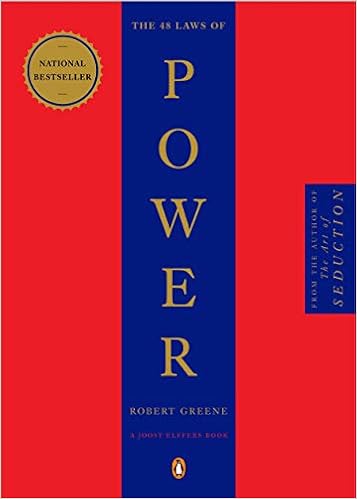
To be taken with a considerable grain of salt, this book is a worthy update of and complements Machiavelli’s almost 500-years old treatise of power and politics.
“Amoral or immoral, this compendium aims to guide those who embrace power as a ruthless game, and will entertain the rest. Elffers’s layout (he is identified as the co-conceiver and designer in the press release) is stylish, with short epigrams set in red at the margins. Each law, with such allusive titles as “Pose as a Friend, Work as a Spy,” “Get Others to Do the Work for You, But Always Take the Credit,” “Conceal Your Intentions,” is demonstrated in four ways: using it correctly, failing to use it, key aspects of the law and when not to use it. Illustrations are drawn from the courts of modern and ancient Europe, Africa and Asia, and devious strategies culled from well-known personae: Machiavelli, Talleyrand, Bismarck, Catherine the Great, Mao, Kissinger, Haile Selassie, Lola Montes and various con artists of our century. These historical escapades make enjoyable reading, yet by the book’s conclusion, some protagonists have appeared too many times and seem drained. Although gentler souls will find this book frightening, those whose moral compass is oriented solely to power will have a perfect vade mecum.”
In 2007, the Academy of Management Annual Meeting will be hosted by my wife’s beloved hometown Philadelphia, PA. Under the conference theme “Doing well by doing good”, we will present our paper:
“What’s in a tie? Knowledge transfer and the dimensions of dyadic social capital” with Daniel Z. Levin (Rutgers University) & Melissa M. Appleyard (Portland State University).
The conference will take place August 3-8, 2007. For more information, check the AOM website.
This trip also offers an opportunity to visit my old friend Florian, who is currently holding a postdoctoral position at the University of Pennsylvania, and his wife Andrea during the last 4 months of their stay in this fantastic city.
This year’s Strategic Management Society’s Annual International Conference with the title “Strategy and Governance in a World of Institutional Change” took place October 29 – November 1 in Vienna, Austria. Together with my co-authors I presented the paper:
“Organizational structure and corporate entrepreneurship: A simulation model” with Dirk Martignoni (University of St. Gallen) & Franz W. Kellermanns (Mississippi State University).
For more information on the SMS Conference, visit their website.
This year’s Academy of Management Annual Meeting with the title “Knowledge, Action and the Public Concern” took place August 11-16 in Atlanta, GA. Although I could not participate due to my wedding in Philadelphia, my co-authors presented our paper:
“To agree or not to agree? A meta-analytical review of strategic consensus and performance” with Franz W. Kellermanns (Mississippi State University), John C. Shaw (Mississippi State University), Christoph Lechner (University of St. Gallen), & Steven W. Floyd (University of Connecticut).
After a great year at the University of Connecticut, I am excited to start my tenure-track position as Assistant Professor at Portland State University’s School of Business Administration. From September 2006, I will teach the undergraduate capstone course in strategic management and pursue my research projects in this fantastic West Coast city.
Erin and I will spend the Christmas holidays in Munich, Germany. And we finally managed to get the entire group of German friends together in Munich for the holidays…
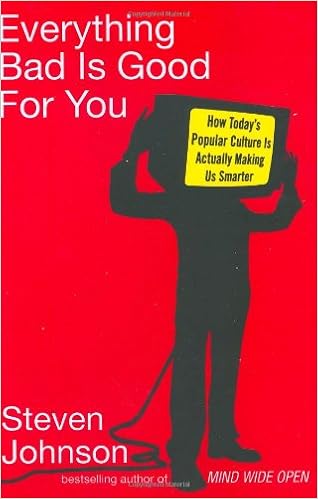
In his fourth book, Everything Bad Is Good for You, iconoclastic science writer Steven Johnson (who used himself as a test subject for the latest neurological technology in his last book, Mind Wide Open) takes on one of the most widely held preconceptions of the postmodern world–the belief that video games, television shows, and other forms of popular entertainment are detrimental to Americans’ cognitive and moral development. Everything Good builds a case to the contrary that is engaging, thorough, and ultimately convincing.
The heart of Johnson’s argument is something called the Sleeper Curve–a universe of popular entertainment that trends, intellectually speaking, ever upward, so that today’s pop-culture consumer has to do more “cognitive work”–making snap decisions and coming up with long-term strategies in role-playing video games, for example, or mastering new virtual environments on the Internet– than ever before. Johnson makes a compelling case that even today’s least nutritional TV junk food–the Joe Millionaires and Survivors so commonly derided as evidence of America’s cultural decline–is more complex and stimulating, in terms of plot complexity and the amount of external information viewers need to understand them, than the Love Boats and I Love Lucys that preceded it. When it comes to television, even (perhaps especially) crappy television, Johnson argues, “the content is less interesting than the cognitive work the show elicits from your mind.”
Johnson’s work has been controversial, as befits a writer willing to challenge wisdom so conventional it has ossified into accepted truth. But even the most skeptical readers should be captivated by the intriguing questions Johnson raises, whether or not they choose to accept his answers. –Erica C. Barnett, Amazon.com
Duncan J. Watts, one of the principal architects of network theory, sets out to explain the innovative research he and other scientists are spearheading to create a blueprint of our connected planet.
You may be only six degrees away from Kevin Bacon, but would he let you borrow his car? It depends on the structures within the network that links you. When the power goes out, when we find that a stranger knows someone we know, when dot-com stocks soar in price, networks are evident. In Six Degrees, sociologist Duncan Watts examines networks like these: what they are, how they’re being studied, and what we can use them for. To illustrate the often complicated mathematics that describe such structures, Watts uses plenty of examples from life, without which this book would quickly move beyond a general science readership. Small chapters make each thought-provoking conclusion easy to swallow, though some are hard to digest. For instance, in a short bit on “coercive externalities,” Watts sums up sociological research showing that:
“Conversations concerning politics displayed a consistent pattern …. On election day, the strongest predictor of electoral success was not which party an individual privately supported but which party he or she expected would win.”
Six Degrees attempts to help readers understand the new and exciting field of networks and complexity. While considerably more demanding than a general book like The Tipping Point, it offers readers a snapshot of a riveting moment in science, when understanding things like disease epidemics and the stock market seems almost within our reach.
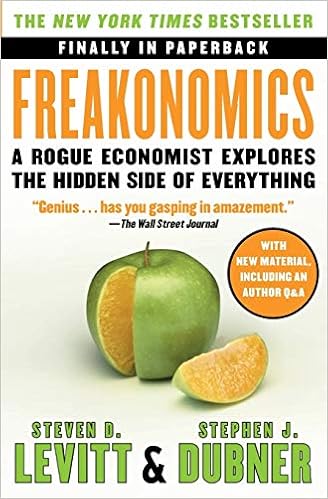
Through forceful storytelling and wry insight, Levitt and co-author Stephen J. Dubner show that economics is, at root, the study of incentives – how people get what they want, or need, especially when other people want or need the same thing. In Freakonomics, they set out to explore the hidden side of … well, everything.
Which is more dangerous, a gun or a swimming pool? What do schoolteachers and sumo wrestlers have in common? Why do drug dealers still live with their moms? How much do parents really matter? What kind of impact did Roe v. Wade have on violent crime?
These may not sound like typical questions for an economist to ask. But Steven D. Levitt is not a typical economist. He is a much-heralded young scholar who studies the riddles of everyday life-from cheating and crime to sports and child-rearing – and whose conclusions regularly turn the conventional wisdom on its head. He usually begins with a mountain of data and a simple, unasked question. Some of these questions concern life-and-death issues; others have an admittedly freakish quality. Thus the new field of study contained in this book: Freakonomics.
Through forceful storytelling and wry insight, Levitt and co-author Stephen J. Dubner show that economics is, at root, the study of incentives – how people get what they want, or need, especially when other people want or need the same thing. In Freakonomics, they set out to explore the hidden side of … well, everything. The inner workings of a crack gang. The truth about real-estate agents. The myths of campaign finance. The telltale marks of a cheating schoolteacher. The secrets of the Ku Klux Klan.
What unites all these stories is a belief that the modern world, despite a surfeit of obfuscation, complication, and downright deceit, is not impenetrable, is not unknowable, and – if the right questions are asked – is even more intriguing than we think. All it takes is a new way of looking. Steven Levitt, through devilishly clever and clear-eyed thinking, shows how to see through all the clutter.
Freakonomics establishes this unconventional premise: if morality represents how we would like the world to work, then economics represents how it actually does work. It is true that readers of this book will be armed with enough riddles and stories to last a thousand cocktail parties. But Freakonomics can provide more than that. It will literally redefine the way we view the modern world.
I am very glad to announce that my mentor at the University of St. Gallen, Christoph Lechner, and my mentor at the University of Connecticut, Steven W. Floyd, won the prestigious Strategic Management Society (SMS) Best Conference Paper Prize for their paper:
“The role of authority, justification, and coalition-building in strategic renewal.”
Congratulations also from my side for this tremendous achievement!
In spite of the hurricane “Wilma”, this year’s Annual International Meeting of the Strategic Management Society took place in the Walt Disney World Resort in Orlando, FL. The theme for this year was “Strategic Management Achievements & Opportunities”.
Together with my co-authors, I presented two papers there:
“Strategic decision-making at the firm and alliance level: An empirical study” with Franz W. Kellermanns (Mississippi State University), and
“Motives and outcomes of technology licensing: An exploratory study of the
pharmaceutical and computer industries” with Melissa A. Schilling (New York University).
For more information on the SMS Meeting, visit their website.
The Lack of Consensus About Strategic Consensus: Advancing Theory and Research
Franz W. Kellermanns*, Jorge Walter**, Christoph Lechner***, & Steven W. Floyd**
* Mississippi State University, ** University of Connecticut, *** University of St. Gallen
The purpose of this article is to describe the theoretical and methodological reasons for the inconsistent findings on the value of strategic consensus. This analysis suggests the need for (a) definitions of consensus that align the locus and content of agreement with the study context and theoretical premises; (b) measures of consensus that take account of locus as well as differences in how the content of strategy is perceived by top-, middle-, and lower-level managers; (c) research designs wherein assumptions about the locus and content of consensus govern the choice of antecedents; and (d) more consistent use of moderators.
Keywords: Strategic consensus; consensus decision making; strategic decision making
After my year as postdoc at New York University’s Stern School of Business, I have accepted a one-year appointment as assistant professor in residence at the University of Connecticut’s School of Business. I will be teaching the capstone courses in strategic management at the undergraduate level and the MBA level.
The Academy of Management Annual Meeting took place from August 5-10,
2005, in Honolulu, Hawaii, and featured the theme “A new vision of
management in the 21st century”. For more information about the meeting
see their website.
Together with my co-authors, I presented two papers at this year’s AOM Annual Meeting:
‘Resource-based and network-based motives for technology licensing: An exploratory study’, with Melissa A. Schilling (New York University).
‘Together or apart? An empirical investigation of decision making within and between alliance partners’, with Christoph Lechner (University of St. Gallen).
An estimated 1.5 million people gathered in Philadelphia and in nine other spots around the world on Saturday for a series of free concerts meant to persuade world leaders to give more money to fight poverty in Africa.



























 Jorge Walter's Blog