Our team scored 3rd place in their division in this year’s Odyssey of the Mind tournament!

Congratulations to our team! All your hard work over the last few months really paid off!
Our team scored 3rd place in their division in this year’s Odyssey of the Mind tournament!
Congratulations to our team! All your hard work over the last few months really paid off!
I have just received notice from the GWSB Doctoral Student Association that I have been nominated for this year’s Peter B. Vaill Outstanding Doctoral Educator Award!

This represents my fourth nomination in the six years I’ve been here at GW (including winning this award in 2014). Thanks to our doctoral students for nominating me again!
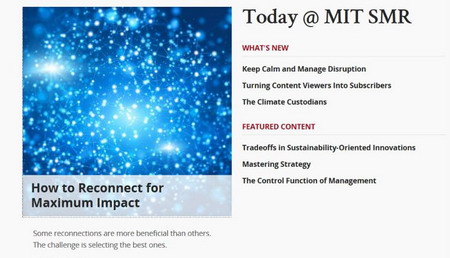
Happy to share that our new article on reconnecting dormant ties has just appeared in MIT Sloan Management Review.
While our previous research has found that rekindling dormant professional relationships can offer tremendous career benefits to executives, our new study shows that some reconnections are more beneficial than others — and that executives often don’t select the best reconnection choices.
In particular, reconnecting with long-lost or dormant contacts can be very valuable — both professionally and personally. But choosing from among hundreds of former contacts can be challenging. We find that executives, when left to their own devices, don’t take full advantage of their opportunities to reconnect. And when they do reconnect, they tend to focus on comfort and not on re-connections that might offer the best advice.
To get the most out of reconnecting, however, you have to seek out former contacts who are likely to engage with you and to provide you with novelty. To achieve more novelty, this may mean going outside your usual comfort zone and reaching out to higher-status people or to people you didn’t know very well to begin with. But these are exactly the kinds of reconnections that can best point you in a new direction, tell you something you don’t already know, and help you make the most of dormant connections in your network.
Read the full article here.
Thrilled to share that I have recently been awarded a two-year Ave Tucker Fellowship at George Washington University’s School of Business.
Named after George Washington University’s Board of Trustee member Avram S. Tucker, this fellowship recognizes faculty members who “displayed good teaching performance, as well as recent scholarly productivity, prospects for continued publications in top outlets, and records of research leadership and mentoring of junior scholars.”
Thanks to the GWSB Executive Committee for bestowing this great honor on me!
Following an invitation from our friends who are spending their sabbatical in Frisco, CO, we spent the holidays skiing in the Colorado mountains.
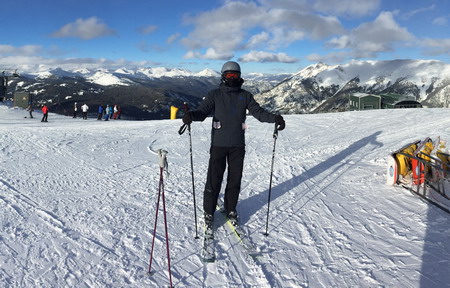
Thanks to Jennifer & Jorge for making this unforgettable trip happen!

…from the Walter Family!

Thanks to Loudoun Soccer and my co-coaches for another great soccer season for our team!

This year’s Strategic Management Society’s Annual International Conference took place in Denver, CO, and Stefan Haefliger and I chaired a Professional Development Workshop titled “Innovation & network strategy junior faculty and paper development workshop.”
For more information, check the SMS Website.

This year’s Academy of Management Annual Meeting took place from August 7-11 in Vancouver, BC, where I presented our paper:
For the second year in a row, I also received the Outstanding Reviewer Award for the Business Policy and Strategy Division of the Academy of Management.
For more information, check the AOM Website.

Spent the day hiking with Jorge Rivera on Old Rag Mountain, although hiking is a little bit of an understatement–I should’ve known that the National Park Services mean it when they call this “Shenandoah’s most popular and most dangerous hike”
This week, I also accepted an invitation to present our paper “Antecedents and outcomes of peer control: A multi-level analysis” (co-authored with Markus & Karin Kreutzer) at Cass Business School, City University London.

Thanks to Stefan Haefliger for his kind invitation and for hosting me in this fantastic city, and to the Cass faculty members and doctoral students for their helpful comments on our paper.
This week, I accepted Markus Kreutzer’s kind invitation to join him and his colleagues for the European Business School’s Annual Off-Site Doctoral Workshop at Kloster Johannisberg in the beautiful Rhine Valley.

Besides the inevitable sightseeing and wine tasting, I learned a lot about the impressive research the EBS doctoral students are conducting. So thanks for having me!
The back end of my sabbatical in Europe is getting busier: I just spent the last two days in St. Gallen to attend a Special Conference of the Strategic Management Society on the topic “Rethinking Corporate Headquarters: Innovative Approaches for Managing the Multi-Divisional Firm.” I also served as a panel member for the doctoral/junior faculty workshop organized by Matthias Brauer & Tina Ambos.

New Article provisionally accepted in Organization Science:
Reconnection choices: Selecting the most valuable (vs. most preferred) dormant ties
Jorge Walter*, Daniel Z. Levin**, & J. Keith Murnighan***
* The George Washington University, ** Rutgers University, *** Northwestern University
Recent research has shown that reconnecting long-lost, dormant ties can yield tremendous value, often more than active ties. Yet two key research questions remain unanswered: which of a person’s many dormant ties provide the most value, and which are advice seekers most inclined to choose as reconnection targets? In the current study, we asked executives to seek advice on an important work project from two dormant ties (their first, most preferred choice plus one selected randomly from their next nine most preferred choices) and to respond to surveys before and after their reconnections. This two-stage design allowed us to make causal inferences about the executives’ advice-seeking preferences and the value of reconnecting certain types of dormant ties. Our results show that the most valuable reconnections are to people who provide novelty (by not having spent much time together in the past and being higher status) as well as engagement (by being trustworthy and willing to help). Our executive participants, however, preferred neither novelty nor engagement. Rather, the prospect of reconnecting can make people feel anxious. To avoid this discomfort, executives preferred contacts with whom they had spent a lot of time together in the past, thereby actually reducing novelty. Thus, our findings identify critical biases in executives’ reconnection preferences as well as insights into how to make more effective reconnections. Our discussion presents broader implications of these findings for advice seeking and social networks.
Keywords: Knowledge transfer, interpersonal ties, social exchange
This week, I also visited Tilburg University to present our paper “Prior experience, bargaining power, and exclusivity in technology licensing agreements” (co-authored with Ted Khoury & Erin Pleggenkuhle-Miles).

My gratitude to Nufer Ates for kindly hosting me during my visit and to all faculty members and doctoral students for their insightful feedback on our study!
Just came back from a visit to Rotterdam, where I presented our new working paper on “Antecedents and outcomes of peer control: A multi-level analysis” (co-authored with Markus & Karin Kreutzer) at the Rotterdam School of Management at Erasmus University.
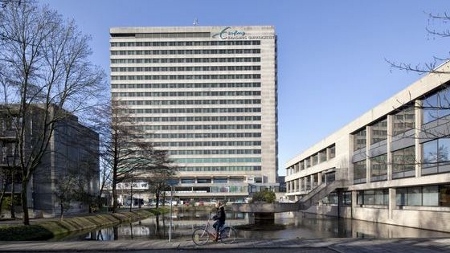
Thanks to my host, Murat Tarakci, for making this happen and to all the brown bag participants for their great feedback on our study!
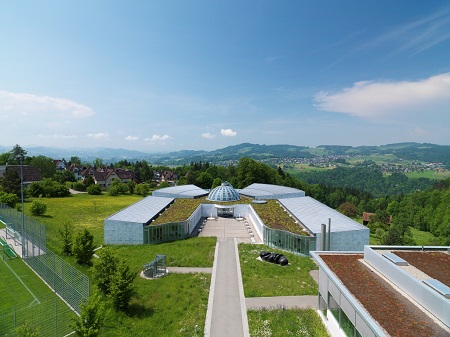
Just returned from teaching my first Executive MBA seminar at the University of St. Gallen in Switzerland. Besides feeling nostalgic about returning to my Alma Mater after more than 10 years, I was very impressed with the university’s executive education program as well as with the qualifications, experience, and interest of the attending executives.
Many thanks to my former doctoral adviser, Günter Müller-Stewens, for inviting me and to the executives for having me. I look forward to coming back next week for my second seminar.

Today, I gave an invited research talk on our paper “Prior experience, bargaining power, and exclusivity in technology licensing agreements” (with Ted Khoury and Erin Pleggenkuhle-Miles) to the Faculty of Business and Economics (HEC) at the University of Lausanne in Switzerland.
I had a great time in this beautiful part of Switzerland and also received some very insightful feedback on our paper.
Thanks to Xavier Castañer for his kind invitation and to Déborah Philippe who kindly hosted me during my visit!

My family, parents, and I just spent three nights in the Swiss Alps, in the same village I spent my Easter and Christmas holidays as a child. Sophia and Max loved it–and became quite impressive skiers, as did Erin…

Very excited to start my six-months sabbatical, particularly since it brings me and my family to Europe. For the next four months, we will be based in Munich, Germany, from where I will travel throughout Europe to visit universities, meet with colleagues, and present my current and develop new research projects, while the kids learn German and get immersed in the local culture and lifestyle…
New Article Forthcoming in Group & Organization Management:
Daniel Z. Levin*, Jorge Walter**, Melissa M. Appleyard***, & Rob Cross****
* Rutgers University, ** The George Washington University, *** Portland State University, **** University of Virginia
We propose and test a novel approach to the dilemma that the very network-bridging structure most likely to provide access to novel knowledge may be ill-suited for the cooperation needed to successfully transfer that knowledge. We theorize that the relational dimension of social capital (e.g., tie strength) can act as a substitute for the structural benefits of network closure, and so a network-bridging tie yields more value when it is also strong. We further investigate if it is emotional closeness, interaction frequency, or trust that underlies this “relational enhancement” effect; our results identify the key mechanism as trust.
Keywords: Knowledge transfer, social capital, structural holes, tie strength, trust
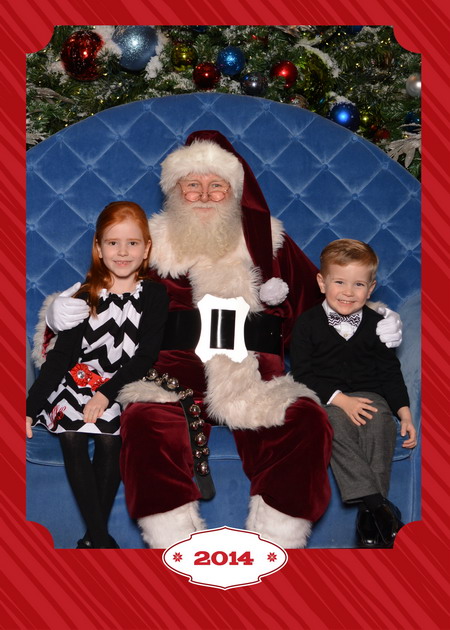
…from the Walter family!
Thanks to the members of the Strategy Process Interest Group (IG) of the Strategic Management Society (SMS) for electing me as one of three new Representatives-at-Large!
For more information on the Strategy Process IG, click here.
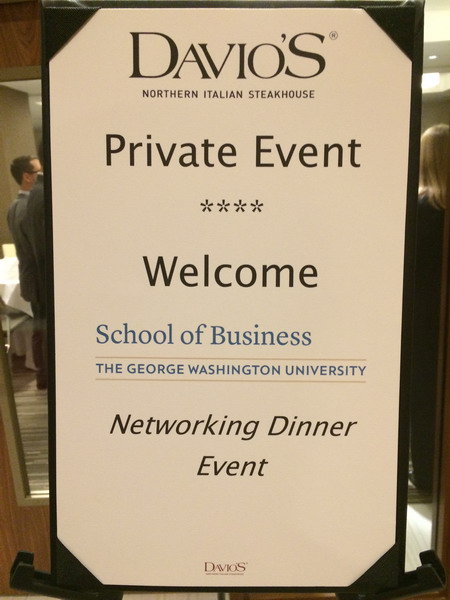
Just returned from this year’s GWSB New York City Networking Trek with our undergraduate students. It was a great experience for both students and faculty, so thanks to Associate Dean Isabelle Bajeux-Besnainou for her kind invitation!

This year’s Strategic Management Society’s Annual International Conference took place in Madrid, Spain, and we presented our paper
which was also nominated for the Strategic Management Society Best Conference Paper Price Award, the Strategic Management Society Best Conference Paper for Practice Implications Award, and was a Finalist for the Strategic Management Society Best Conference Paper of the Strategy Process Interest Group. For more information, check the SMS Website.
 Jorge Walter's Blog