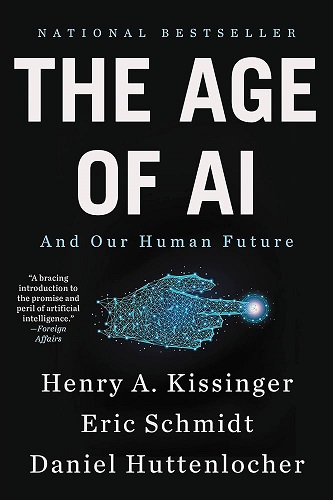
The second book on AI by some of the world’s most renown thinkers on technology and society–and Henry Kissinger’s last book–that offers a number of insightful reflections on the impact of AI on our human society and beyond.
Another incredibly insightful book from the Harvard Negotiation Project. I received this as part of a recent faculty leadership training, and I already find it indispensable in my new role as department chair.
“Whether dealing with an underperforming employee or a challenging colleague, disagreeing with your spouse about money or child-rearing, negotiating with a client, or simply saying “No,” “I’m sorry,” or “I love you,” we attempt or avoid difficult conversations every day. No matter how competent we are, we all have conversations that cause anxiety and frustration.This book can help. Based on almost thirty years of research, Difficult Conversations walks you through a step-by-step approach for how to have your toughest conversations with less stress and more success.”
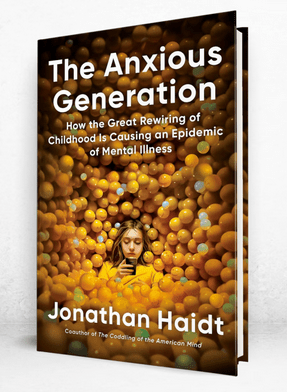
Although controversial in some circles, in my view a “must-read for all parents: the generation-defining investigation into the collapse of youth mental health in the era of smartphones, social media, and big tech—and a plan for a healthier, freer childhood.”
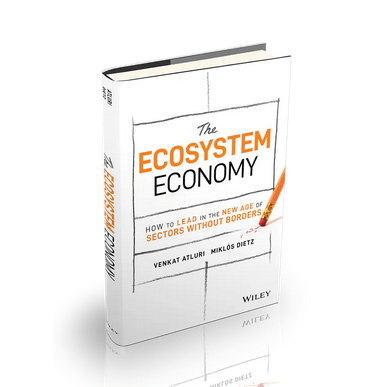
Read this one in preparation for my new elective on “Advanced Strategic Management.” And I agree that “The Ecosystem Economy offers a compelling new take on how the global economy is being fundamentally transformed by the acceleration of new technology development, evolving consumer preferences and behaviors, business models and organizational and performance management constructs.”
Just finished the second book authored by clinical psychologist Dr. Lisa Damour. Complementing and extending her prior book, “Untangled,” her most recent book, “The Emotional Lives Of Teenagers” combats the prevalent myths that (1) emotion is the enemy of reason, (2) difficult emotions are bad and should be avoided at all cost, and (3) their amped-up emotions make teens psychologically fragile. Instead, this book provides a detailed and illustrative discussion of how we as parents could support our teenagers to understand and manage their emotions to become capable and compassionate adults.
And for all of us it contains the important reminder that: “Mental health is not about feeling good. Instead, it’s about having the right feelings at the right time and being able to manage those feelings effectively.”
Just finished reading–OK, I was listening to it on Kindle–this book that came highly recommended by a number of friends. “Untangled” by Dr. Lisa Damour offers indispensable advice for all of us who are raising strong and independent teenage daughters:
“Raising a young woman will be one of the most vexing, delightful, exhausting, and fulfilling things you will ever do. Sometimes all on the same day. The job is hard enough even under the best conditions, and anyone doing a hard job deserves support. When we get that support, when we understand the developmental tour de force that is adolescence, we can truly enjoy and empower our girls.”
Ever since my old friend and mentor Christoph invited me to a talk by Jacques Herzog in Switzerland many years ago, I always loved it when an expert in a field manages to invite the audience into his/her mind. This is also why I had so much fun listening to David Kyle Johnson’s course on “Sci-Phi: Science Fiction as Philosophy.” As part of “The Great Courses,” this audio course discusses contemporary and classic science fiction–from Mary Shelley’s Frankenstein, Dr. Who, and Star Trek, to my personal favorite, Christopher Nolan’s Interstellar–to explore key questions of philosophy.
With Sophia being a rising high school junior, I am starting to wrap my head around the fact that we will have to make some plans for college soon. After almost two decades of being a university professor, “The price you pay for college” by Ron Lieber was incredibly helpful for me to see the college landscape from a student (and parent!) perspective and understand what empirical evidence we have about college choices and outcomes.
By Henry Kissinger, Eric Schmidt, & Daniel Huttenlocher (Little, Brown and Company)
“Three of the world’s most accomplished and deep thinkers come together to explore Artificial Intelligence (AI) and the way it is transforming human society—and what this technology means for us all.”
A must read for anyone anxious or excited about the advent of this groundbreaking new technology!
Used our beach vacation to finish another book my friend and colleague Jorge Rivera had recently recommended: “Four Thousand Weeks: Time Management for Mortals” by Oliver Burkeman. This time-management book is profoundly skeptical of time-management advice while, at the same time, providing some real food for thought about life’s priorities. In a nutshell: Life is short. Most of us get on average about 4,000 weeks. So what are you going to do with that time?
Just finished reading “The extended mind: The power of thinking outside the brain” by Annie Murphy Paul. Fascinating discussion of state-of-the art research on why and how we do (and should!) use our body for thinking; how our physical surroundings impact our thought processes; and how to capitalize on our social relationships to improve our thinking. Check out Adam Grant’s podcast to hear the author provide an insightful summary of the book.
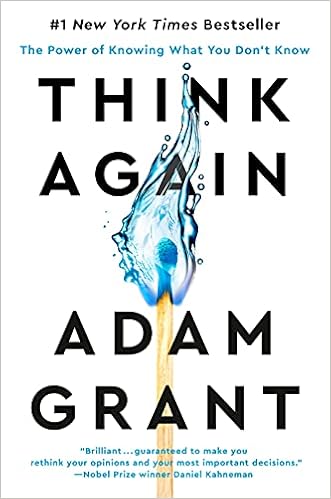
“The whole problem with the world is that fools and fanatics are always so certain of themselves, and wiser people so full of doubts.” —Bertrand Russell
With misinformation, fake news, and strong believers all around us, Adam Grant provides a research-based recipe to help us change our minds (and maybe even those of others).
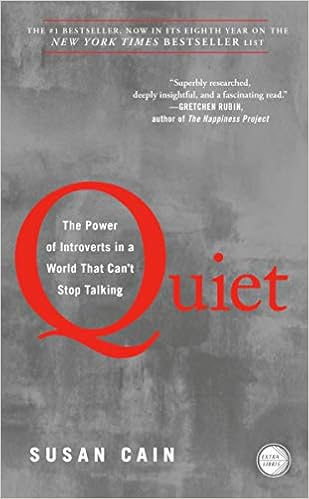
At least one-third of the people we know are introverts. They are the ones who prefer listening to speaking; who innovate and create but dislike self-promotion; who favor working on their own over working in teams. It is to introverts—Rosa Parks, Chopin, Dr. Seuss, Steve Wozniak—that we owe many of the great contributions to society.
In Quiet, Susan Cain argues that we dramatically undervalue introverts and shows how much we lose in doing so. She charts the rise of the Extrovert Ideal throughout the twentieth century and explores how deeply it has come to permeate our culture. She also introduces us to successful introverts—from a witty, high-octane public speaker who recharges in solitude after his talks, to a record-breaking salesman who quietly taps into the power of questions. Passionately argued, superbly researched, and filled with indelible stories of real people, Quiet has the power to permanently change how we see introverts and, equally important, how they see themselves.
Recently read this book for a joint research project on the future of work and highly recommend this insightful primer on how artificial intelligence is going to change our world.
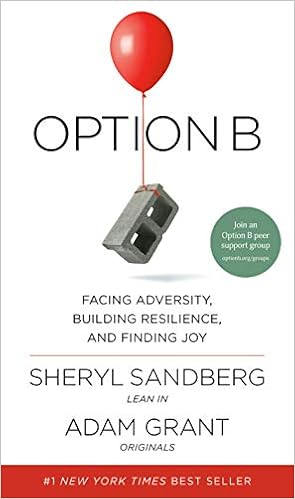
Resilience comes from deep within us and from support outside us. Even after the most devastating events, it is possible to grow by finding deeper meaning and gaining greater appreciation in our lives. Option B illuminates how to help others in crisis, develop compassion for ourselves, raise strong children, and create resilient families, communities, and workplaces. Many of these lessons can be applied to everyday struggles, allowing us to brave whatever lies ahead.
By Greg Lukianoff & Jonathan Haidt (Penguin Press)
In this scathing indictment of recent trends in parenting, education, politics, and the media, a First Amendment expert and a social psychologist take on three “great untruths”–what doesn’t kill you makes you weaker; always trust your feelings; and life is a battle between good people and evil people–that contradict basic psychological principles about well-being and that result in a culture of safetyism which interferes with young people’s social, emotional, and intellectual development.
This excellent analysis of how “good intentions and bad ideas are setting up a generation for failure” is a must-read for young parents, educators, and anyone else interested in the future of our democracy.
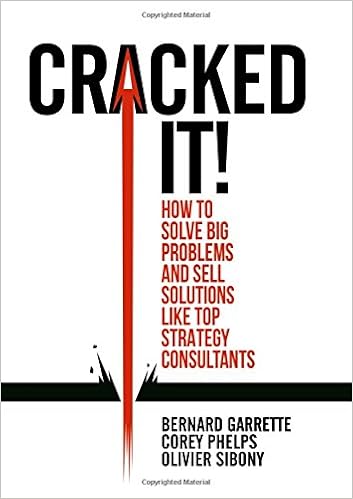
By Bernard Garrette, Corey Phelps, & Olivier Sibony (Palgrave Macmillan)
Just used this book for the first time in my undergraduate strategy capstone course with very positive student reactions…
Solving complex problems and selling their solutions is critical for personal and organizational success. For most of us, however, it doesn’t come naturally and we haven’t been taught how to do it well. Research shows a host of pitfalls trips us up when we try: We’re quick to believe we understand a situation and jump to a flawed solution. We seek to confirm our hypotheses and ignore conflicting evidence. We view challenges incompletely through the frameworks we know instead of with a fresh pair of eyes. And when we communicate our recommendations, we forget our reasoning isn’t obvious to our audience.
How can we do it better?
In Cracked It!, seasoned strategy professors and consultants Bernard Garrette, Corey Phelps and Olivier Sibony present a rigorous and practical four-step approach to overcome these pitfalls. Building on tried-and-tested (but rarely revealed) methods of top strategy consultants, research in cognitive psychology, and the latest advances in design thinking, they provide a step-by-step process and toolkit that will help readers tackle any challenging business problem. Using compelling stories and detailed case examples, the authors guide readers through each step in the process: from how to state, structure and then solve problems to how to sell the solutions. Written in an engaging style by a trio of experts with decades of experience researching, teaching and consulting on complex business problems, this book will be an indispensable manual for anyone interested in creating value by helping their organizations crack the problems that matter most.
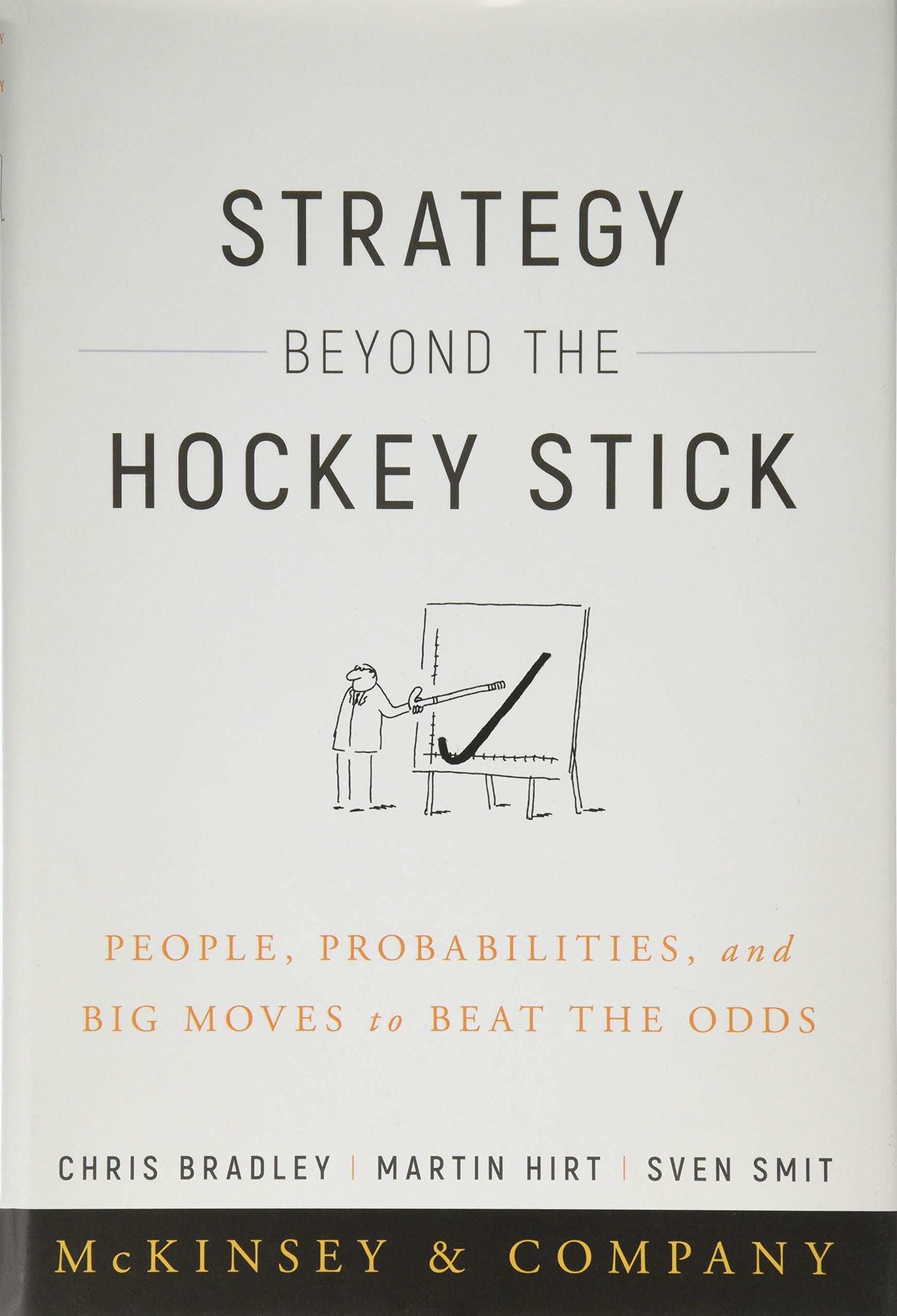
By Chris Bradley, Martin Hirt, & Sven Smit (Wiley)
Several times a year, top management teams enter the
strategy room with lofty goals and the best of intentions: they hope to assess
their situation and prospects honestly, and mount a decisive, coordinated
response toward a common ambition. Then reality intrudes. By the time they get
to the strategy room, they find it is already crowded with egos and competing
agendas. Jobs—even careers—are on the line, so caution reigns. The budget
process intervenes, too. You may be discussing a five-year strategy, but
everyone knows that what really matters is the first-year budget. So, many
managers try to secure resources for the coming year while deferring other
tough choices as far as possible into the future.
Strategy Beyond the Hockey Stick explores in depth the social dynamics that undermine strategic dialogue and breed incrementalism. It also underscores the real, and very challenging, odds of crafting strategies that will lead to dramatic performance improvement.
A little more controversial than my usual business book recommendations, Hillbilly Elegy paints a striking and thought-provoking portrait of contemporary America and is definitely worth a read.
This book has literally changed the way I approach relationships–must read for everyone interested in social networking! In a nutshell, givers succeed in life and the workplace because we all root for givers and gun for takers!
Disclaimer: Must say I am not entirely unbiased, though, as Adam Grant devotes an entire section in this book to discussing our research on dormant ties…
“Given the opportunity to watch the inner workings of his own brain, Steven Johnson jumps at the chance. He reveals the results in Mind Wide Open, an engaging and personal account of his foray into edgy brain science.”
“In the 21st century, Johnson observes, we have become used to ideas such as ‘adrenaline rushes’ and ‘serotonin levels,’ without really recognizing that complex neurobiology has become a commonplace thing to talk about. He sees recent laboratory revelations about the brain as crucial for understanding ourselves and our psyches in new, post-Freudian ways. Readers shy about slapping electrodes on their own temples can get a vicarious scientific thrill as Johnson tries out empathy tests, neurofeedback, and fMRI scans. The results paint a distinct picture of the author, and uncover general brain secrets at the same time. Memory, fear, love, alertness–all the multitude of states housed in our brains are shown to be the results of chemical and electrical interactions constantly fed and changed by input from our senses. Mind Wide Open both satisfies curiosity and provokes more questions, leaving readers wondering about their own gray matter.”
“The best way to understand the dramatic transformation of unknown books into bestsellers, or the rise of teenage smoking, or the phenomena of word of mouth or any number of the other mysterious changes that mark everyday life,” writes Malcolm Gladwell, “is to think of them as epidemics. Ideas and products and messages and behaviors spread just like viruses do.” Although anyone familiar with the theory of memetics will recognize this concept, Gladwell’s The Tipping Point has quite a few interesting twists on the subject.”
“For example, Paul Revere was able to galvanize the forces of resistance so effectively in part because he was what Gladwell calls a “Connector”: he knew just about everybody, particularly the revolutionary leaders in each of the towns that he rode through. But Revere “wasn’t just the man with the biggest Rolodex in colonial Boston,” he was also a “Maven” who gathered extensive information about the British. He knew what was going on and he knew exactly whom to tell. The phenomenon continues to this day–think of how often you’ve received information in an e-mail message that had been forwarded at least half a dozen times before reaching you.
Gladwell develops these and other concepts (such as the “stickiness” of ideas or the effect of population size on information dispersal) through simple, clear explanations and entertainingly illustrative anecdotes, such as comparing the pedagogical methods of Sesame Street and Blue’s Clues, or explaining why it would be even easier to play Six Degrees of Kevin Bacon with the actor Rod Steiger. Although some readers may find the transitional passages between chapters hold their hands a little too tightly, and Gladwell’s closing invocation of the possibilities of social engineering sketchy, even chilling, The Tipping Point is one of the most effective books on science for a general audience in ages. It seems inevitable that “tipping point,” like “future shock” or “chaos theory,” will soon become one of those ideas that everybody knows–or at least knows by name.”












 Jorge Walter's Blog