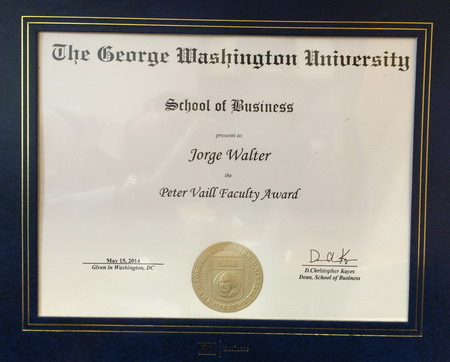
Peter B. Vaill Outstanding Doctoral Educator Award

vaill2014
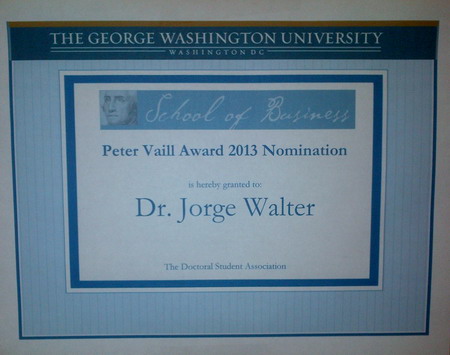
I just received notice that, after being nominated twice (in 2011 and 2013), I was awarded the 2014 Peter B. Vaill Outstanding Doctoral Educator Award by the Doctoral Student Association of the School of Business of The George Washington University.

A sincere thanks to the doctoral students for this honor. I look forward to many more opportunities to engage with the GWSB doctoral program…

New Article Forthcoming in Personnel Psychology

New Article Forthcoming in Personnel Psychology:

Deeds that help and words that hurt: Helping and gossip as moderators of the relationship between leader-member exchange and advice network centrality

Berrin Erdogan*, Talya Bauer*, & Jorge Walter**

* Portland State University, ** The George Washington University

We examine the relationship between leader-member exchange (LMX) quality and advice network centrality using multi-source data from a sample of 250 retail employees and their respective managers in Turkey to test our hypothesized model of value and costs of being sought out for advice. Drawing upon the tenets of Network Generation Theory (Nebus, 2006), we predict that the tendency of focal actors to help others and their own tendency to gossip would be behavioral moderators of the relationship between LMX quality and their advice network centrality. Consistent with Network Generation Theory, our results reveal that LMX quality is positively related to centrality only for those actors with a high tendency to help coworkers and a low tendency to gossip about coworkers, suggesting that behaviors indicating helpfulness and discretion are necessary for high LMX members to maintain a central position in their work group’s advice network. Implications and future research directions are discussed.

Keywords: Leader-member exchange (LMX), advice network centrality, helping behaviors, gossip

For a copy of this article, see here.

2013 SMS Annual International Conference

atlanta2013

This year’s Strategic Management Society’s Annual International Conference took place in Atlanta, GA, and my colleagues and I presented our paper

  • “Experience, negotiation leverage, and their effects on exclusivity in technology licensing agreements” with Ted Khoury (Portland State University) & Erin Pleggenkuhle-Miles (University of Nebraska at Omaha),

which was also nominated for the Strategic Management Society Best Conference Paper Price. For more information, check the SMS Website.

New Article Forthcoming in the Journal of Management

New Article Forthcoming in the Journal of Management:

Learning activities, exploration, and the performance of strategic initiatives

Jorge Walter*, Christoph Lechner**, Franz W. Kellermanns***

* The George Washington University, ** University of St. Gallen, *** University of North Carolina at Charlotte

This study examines the contingent effect of the degree of exploration characterizing strategic initiatives on the relationship between group-level organizational learning activities (i.e., searching, processing, codifying, and practicing) and the performance of strategic initiatives. Results from a sample of 96 strategic initiatives conducted by three large European insurance corporations provide broad, albeit not unanimous, support for our prediction that the four learning activities are more beneficial when the degree of exploration is high. Moreover, for initiatives with lower degrees of exploration, we found no significant association of searching, processing, codifying, or practicing with initiative performance. These findings suggest that effective organizational learning depends not only on investments in learning activities, but also on the alignment between these investments and the degree of exploration inherent in the learning task.

Keywords: Strategic initiatives; group-level organizational learning; degree of exploration

For a copy of this article, please see here.

2013 Academy of Management Annual Meeting

aom2013

This year’s Academy of Management Annual Meeting took place from August 8-13 in Lake Buena Vista, FL. Under the conference theme
“Capitalism in Question,” my colleagues and I presented in the following sessions:

  • “Organizational control as an antidote to politics in the pursuit of strategic initiative performance?” with Markus Kreutzer (University of St. Gallen) & Laura Cardinal (University of Houston) and
  • “Entrepreneurship Division Early Career Development Consortium.” Professional Development Workshop organized by Donna DeCarolis (Rutgers University) & Kim Eddleston (Northeastern University).

For more information, check the AOM Website.

Presentation at 2013 IRI Diamond Jubilee Meeting

irilogo

Today, I had the opportunity to serve as a subject matter expert on the topic "Weak ties and innovation" at the Industrial Research Institute’s Diamond Jubilee Meeting here in Washington, DC. It was a great experience interacting with this audience of high-caliber R&D managers from a wide variety of industry and government, and I hope to continue this dialogue, perhaps in the form of a joint research project, in the future.

Thanks to Natalie Schoch (Kellogg Company), Leonard Huskey (US Army Research Laboratory), and Robert McNamee (Temple University) for their generous invitation!

For more information, check the IRI Website.

Paper nominated for SMS Best Conference Paper Award

Just received notice that one of our submissions to this year’s SMS Conference has received a nomination for the SMS Best Conference Paper Award:

Experience, negotiation leverage, and their effects on exclusivity in technology licensing agreements

Theodore A. Khoury*, Jorge Walter**, & Erin G. Pleggenkuhle-Miles***

* Portland State University, ** The George Washington University, *** University of Nebraska at Omaha

Technology licensing represents a complex area of interfirm contracting due to the highly idiosyncratic nature of these transactions. Focusing on the most valuable, yet often contentious, contractual feature in technology licensing transactions—exclusivity—we examine the differential influence of licensors’ prior experience with out-licensing versus in-licensing technologies. Our study builds on foundational transaction-cost research and develops a theoretical framework explaining whether or not licensors are likely to realize non-exclusive deal outcomes as a function of accumulated licensing experience, and when partner- or market-specific conditions dampen or accentuate the effects of such experience. Leveraging a 26-year sample of 2,664 bioscience-licensing transactions and a novel theoretical framework that accounts for the conditions of negotiation leverage within these unique transactions, we examine how exclusivity provisions vary across technology licenses.

Keywords: Technology licensing; licensing experience; exclusivity; transaction costs; partner prominence; strategic alliances; bioscience industry

For a copy of this article, please contact me directly.

New article forthcoming in the Journal of Small Business Management

New Article Forthcoming in the Journal of Small Business Management:

The resource-based view in entrepreneurship: A content-analytical comparison of researchers’ and entrepreneurs’ views

Franz W. Kellermanns*, Jorge Walter**, T. Russel Crook*, Benedict Kemmerer***, & V. K. Narayanan****

* University of Tennessee, ** The George Washington University, *** Strategic Marketing, Consumer Products Division (CPM-SM), BSH Bosch und Siemens Hausgeräte GmbH, **** Drexel University

The resource-based view (RBV) is one of the most influential perspectives in the organizational sciences. Although entrepreneurship researchers are increasingly leveraging the RBV’s tenets, it emerged in strategic management. Despite some important similarities between entrepreneurship and strategic management, there are also important differences, raising questions as to whether and to what extent the RBV needs to be adapted for the entrepreneurship field. As a first step towards answering these questions, this study focuses on resources as the fundamental building block of the RBV and presents a content-analytical comparison of researchers’ and practicing entrepreneurs’ resource conceptualizations to derive similarities and differences between established theory and entrepreneurial practice. We find that although the two conceptualizations exhibit some overlap, there are also important differences in the emphasis on different dimensions of resources and ownership requirements, as well as in the understanding of how those resources shape outcomes. These results suggest important contextual conditions when applying the RBV’s tenets within the field of entrepreneurship.

Keywords: Strategic consensus, strategic alignment, organizational performance

For a copy of this article, please see here or contact me directly.

New article forthcoming in Strategic Organization

New Article Forthcoming in Strategic Organization:

Strategic alignment: A missing link in the relationship between strategic consensus and organizational performance

Jorge Walter*, Franz W. Kellermanns**, Steven W. Floyd***, John F. Veiga****, & Curtis Matherne*****

* The George Washington University, ** University of Tennessee, **** University of Massachusetts–Amherst, **** University of Connecticut, ***** University of Louisiana Lafayette

Despite the increasing sophistication of the literature on strategic consensus and the compelling arguments linking it to organizational performance, empirical research has produced mixed findings. To address this conundrum, we examine the contingent role of strategic alignment—i.e., to what extent decision makers place importance on strategic priorities that are responsive to, or fit, the demands of the external environment faced by the organization—as a salient missing link. Our findings from a sample of 349 university faculty members in 63 academic departments suggest that the consensus-performance relationship is stronger for lower levels of strategic alignment, whereas at higher levels of alignment, consensus appears to have little effect. Our discussion traces implications of these findings for existing theory and future research.

Keywords: Strategic consensus, strategic alignment, organizational performance

For a copy of this article, please see here or contact me directly.

New article forthcoming in the Academy of Management Journal

New Article Forthcoming in the Academy of Management Journal:

Corporate Control and the Speed of SBU-Level Decision Making

Maximilian Kownatzki*, Jorge Walter**, Steven W. Floyd***, & Christoph Lechner****

* Oliver Wyman, ** The George Washington University, *** University of Massachusetts–Amherst, **** University of St. Gallen

Decision speed has long been recognized as a critical determinant of firm performance, particularly in dynamic environments. Extending prior studies, which have largely focused on firm-level decision speed in small- and medium-sized organizations, this study explores how control mechanisms set by corporate headquarters in multi-business firms influence decision speed at the strategic business unit (SBU) level. Using a multi-method approach, we first inductively derive six types of corporate control, before deductively examining their effects on SBU-level decision speed in five international multi-business organizations. Our results suggest that three corporate control types enhance decision speed (goal setting, extrinsic incentives, and decision process control), two have no effect (negative incentives and conflict resolution), and one has a negative effect (strategy imposition). By integrating results from our qualitative and quantitative analyses, we are also able to identify transparency/alignment, outcome orientation, participation, trust, and timely feedback as the key mechanisms accounting for these effects.

Keywords: Strategic decision processes; decision speed; multi-business organizations; SBUs; corporate control; executives’ mental models; multi-method field study

For a copy of this article, please see here or contact me.